
Welcome to the Mathematical World!
Alessandro Volta
Inventor of the Electric Battery and Pioneer of Electromagnetism
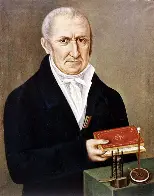
Alessandro Volta (1745–1827) was an Italian physicist and chemist born in Como, Lombardy. He made groundbreaking contributions to the study of electricity and electrochemistry, most notably inventing the first electric battery, the **voltaic pile**, effectively launching the age of electrical science.
Early Career and Discoveries
Volta became a professor of physics at the Royal School in Como in 1774 and later held the chair of experimental physics at the University of Pavia for nearly 40 years :contentReference{index=0}. In 1775, he improved the electrophorus—a device to generate static electricity—and in 1776, he discovered and isolated methane gas :contentReference{index=1}.
Volta vs. Galvani: Uncovering Contact Electricity
In the late 1780s, Volta challenged Luigi Galvani’s theory of “animal electricity” by demonstrating that the twitching of frog legs was due to electrical currents from dissimilar metals—what Volta called “metallic electricity”—not inherent animal force :contentReference{index=2}. This insight led directly to his most famous invention.
The Voltaic Pile
In 1799, Volta built the **voltaic pile**, consisting of alternating discs of zinc and copper separated by brine-soaked cardboard or cloth :contentReference{index=3}. It was the first device to produce a steady, continuous electric current—unlike the static discharge of a Leyden jar—and marked the invention of the modern battery :contentReference{index=4}.
The voltaic pile enabled rapid scientific advances: within weeks, William Nicholson and Anthony Carlisle used it to decompose water by electrolysis, and Humphry Davy discovered new elements such as sodium and potassium :contentReference{index=5}. The volt, now the SI unit of electric potential, was later named in Volta’s honor :contentReference{index=6}.
Recognition and Honors
Volta demonstrated his invention before Napoleon in Paris, who rewarded him with a gold medal and later made him a count and senator of Lombardy :contentReference{index=7}. The Austrian emperor also appointed him director of the philosophy faculty at the University of Padua in 1815 :contentReference{index=8}.
Scientific Legacy
Volta’s work laid the foundation for electrochemistry and the systematic study of electricity. He formulated what became known as **Volta’s law of the electrochemical series**, expressing how differences in electrode potentials drive current generation :contentReference{index=9}. He also studied electrical capacitance, linking electric potential \( V \) and charge \( Q \) through direct proportionality (a principle named Volta’s Law of Capacitance) :contentReference{index=10}.
Commemoration
Volta retired to his estate near Como in 1819 and died in 1827 :contentReference{index=11}. In Como, the **Tempio Voltiano**, a temple-style museum, was built to house his scientific instruments and manuscripts, and stands today as a tribute to his legacy :contentReference{index=12}. The Volta Prize, established by Napoleon III in 1852, was also named in his honor to support achievements related to electricity :contentReference{index=13}.
Legacy
Alessandro Volta’s invention of the voltaic pile not only disproved living tissue as the source of electricity but also created a continuous source of current, revolutionizing scientific exploration. His contributions underpin fundamental concepts in electricity and electrochemistry, and his name lives on in the unit “volt,” the museum honoring his work, and institutions that continue to promote his scientific vision.

All rights reserved by the Mathematical Unity
Contact: +8801400044645
Email: mathematicalhorse1453@gmail.com
Our Discord Server: Mathematical Unity [Ulus Riyadiyat]